
VETERAN ADVOCATES THRIFT EMPORIUM
HEY FOLKS........ THIS EMPORIUM AND THRIFT STORE IS FANTASTIC AND SUCH AN ARRAY OF ITEMS AND CLOTHING!!!!!! GIVE US A SHOT AND COME ON DOWN TO CHECK US OUT YOU'LL HAVE A GOOD TIME!!!!
Veteran Advocates of Ore-Ida has a rathar very nice Thrift Emporium with an excellent selection of donated items !! The prices range from 50 cents up - depending on the kind of items you are shopping for - We have an absolutely WONDERFUL staff of Volunteers eager to help you find items... it is open from 9am to 4pm Monday thru Friday - and you can bring donations Monday thru Friday from 9:30 am to 3:30pm.
Any Questions call 541-889-1978
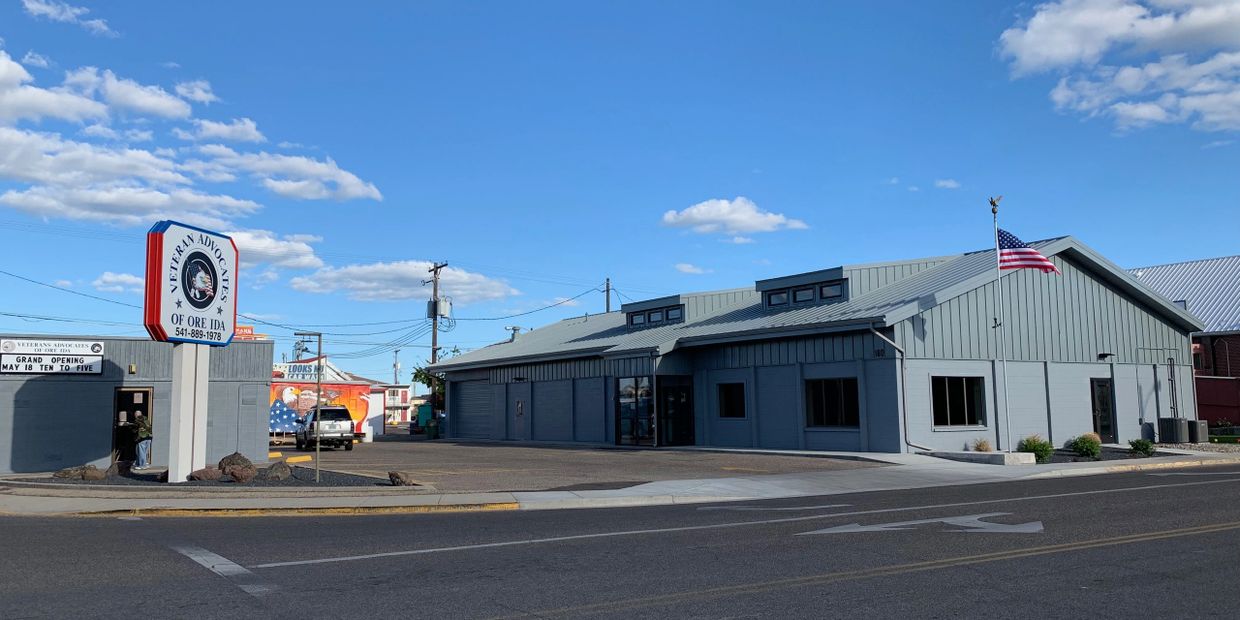
Our Campus Headquarters, Ontario, Oregon
THANK YOU FOR VISITING OUR WEBPAGE!
We thank all the Supporters, Businesses and Friends for giving their time and resources in helping and caring for our Veterans, Military and First Responders and their Families.
We really appreciate your interest too, in 'Who we are and What we do'. If you have any questions or suggestions or would like to 'volunteer' or 'donate', well please contact us with an email or a phone call. Our hours are 9am to 4pm, M/F, so come on in enjoy the conversations and coffee and browse our Museum.
We are a "No Dues' nonprofit organization with the coffee pot always on and lots of conversation always available. Bring your questions regarding any veteran services you are concerned about, and we will do our best to steer you in the right direction.
Our phone is 541-889-1978, and we are located in Ontario, Oregon at 180 W. Idaho Ave.
BI-MONTHLY ARTICLES AND A FEW STORIES OF INTEREST
Veteran Articles published Bi-monthly

The Chairman of Veteran Advocates of Ore-Ida, Ronald Verini, writes two articles every month for publication in a Regional Newspaper, this article ."HAVE WE HANDED THE KEYS TO LUNATICS: WHY OUR VETERANS, WATER, AND FURURE ARE DYING OF AMERICAN APATHY"
will be published SEPTEMBER 2, 2026 Here is a part of Mr. Verini's article, and you can read the full article by clicking the red bar below.
.
HAVE WE HANDED THE KEYS TO LUNATICS: WHY OUR VETERANS, WATER, AND FUTURE ARE DYING OF AMERICAN APATHY
September 2nd, 2026 Veterans Column by Ronald Verini
In my opinion, we need to be honest with ourselves: apathy is killing this country, and silence is the grease on the wheels of government neglect. I am not anti-government; I am anti-stupidity. My opinions are harsh because they have to be. They are meant to be a slap in the face to start conversations that matter, about our military, our veterans, our environment, and our duty to say something, anything, to the elected officials sitting in comfortable chairs while our communities pay the price.
We talk a big game about patriotism, yet we live in a nation where a staggering portion of adults cannot name the three branches of government, let alone explain how a bill becomes law. That isn't just an educational failure; it’s a national security vulnerability. Civics isn't a dusty textbook topic, it’s the steering wheel of our democracy. When you don't know who represents you or what a ballot measure actually does, you hand the keys over to special interests, corporate lobbyists, and career politicians who count on your ignorance. When was the last time you wrote an email, made a call, or showed up to a town hall in Malheur County, Ontario, or across the Western Treasure Valley? If your answer is "never," you have zero right to be surprised when your local rivers are polluted, your roads crumble, and your healthcare options dry up.
Bring it back home. Look at the Western Treasure Valley. The quality of the water you swim in, the air you breathe, and the public lands you hike on exist because of voters. When toxic runoff, agricultural pollution, or industrial dumping degrades local water tables, that isn't an accident, it’s the direct result of who got voted into office and what regulations were gutted behind closed doors. Corporations love deregulation because it cuts overhead and boosts profit margins. But when you strip away environmental oversight, you aren't "cutting red tape", you're trading away clean drinking water and public health so a few executive boardrooms can turn a higher quarterly profit.
And nowhere is this neglect more unforgivable than in how we treat the men and women who put on the uniform to defend us.
We send young men and women off to war, bring them home, and then force them to wage a second, exhausting war against bureaucracy just to get basic healthcare. But the failure starts long before they even leave active duty. Look at military base housing across the nation. Department of Defense Inspector General audits and independent investigations repeatedly reveal active-duty families living in housing plagued by toxic black mold, sewage backups, rodent infestations, and severe moisture hazards. From Joint Base Lewis-McChord to installations nationwide, families have been left living in homes contaminated with spores that eat away at their respiratory systems, all while privatized housing contractors collect military basic allowances for housing and ignore work orders. Why? Because we allowed the folks maintaining those bases to get away with it year after year without holding their feet to the fire.
Look at historical tragedies like Camp Lejeune or Fort Ord, where toxic chemicals, carcinogenic solvents like TCE, and hazardous waste were dumped into local drinking water for decades. Thousands of veterans and their family members developed rare cancers, blood disorders, and birth defects. For years, the Department of Veterans Affairs and federal agencies leaned on outdated science or bureaucratic stalling to deny coverage and disability claims to sick veterans. It took decades of relentless public pressure and legislative fights like the PACT Act to finally start forcing the federal government to compensate those exposed to burn pits and toxic water. That delay didn't happen in a vacuum, it happened because the general public sat on its hands while a small, exhausted minority of veterans and advocates fought the government alone.
National POW/MIA Recognition Day

OBSERVED ANNUALLY · THIRD FRIDAY OF SEPTEMBERPOW/MIA
RECOGNITION DAY
The only official national day of observance dedicated entirely to honoring Americans who were prisoners of war or remain missing and unaccounted for - from all conflicts, in all theaters, and from every branch of service.
SEPTEMBER 18
2026
NEXT OBSERVANCEHISTORY OF THE DAY
From its origins to a nationally codified annual observance now held worldwide, National POW/MIA Recognition Day has grown alongside the League's own five-decade effort to hold the country to its promise that none are forgotten or left behind.
PRECURSORS
Jimmy Carter - National Day of Prayer for those missing
The First National Commemoration
Until July 18, 1979, no special commemoration had been held to honor America's POW/MIAs — those returned and those still missing and unaccounted for. That first year, resolutions were passed in Congress and the national ceremony was held at the National Cathedral in Washington, DC. A Missing Man Formation was flown by the 1st Tactical Squadron, Langley AFB, Virginia. The Veterans Administration published a poster bearing the letters "POW/MIA."
A MORE URGENT SYMBOL
The simple "POW/MIA" text poster format was replaced with a black and white drawing of a POW in harsh captivity — designed to convey the urgency of the situation and the priority that President Ronald Reagan assigned to achieving the fullest possible accounting for Americans still missing from the Vietnam War. For the following decade, various renditions of the American Eagle by artist and Vietnam Veteran Tom Nielsen came to symbolize America's POW/MIAs and the nation's determination to account for them.
A White House Ceremony — and a Debate Over Dates
The 1984 National POW/MIA Recognition Day ceremony was held at the White House, hosted by President Reagan. It remains among the most impressive ceremonies in the observance's history — the Missing Man Formation flown up the Ellipse and directly over the White House was described by witnesses as perhaps the most remarkable ever. That year, the American Ex-POWs had advocated for April 9th — the date during World War II when the largest number of Americans were captured. Legislation covering both dates was passed: July 20, 1984 (as initially proposed) and April 9, 1985. The April ceremony had to be cancelled due to inclement weather — a concern that had been raised from the start about an April date.
Steps of the Capitol, Facing the National Mall
The September 19, 1986 national ceremony was held on the steps of the U.S. Capitol facing the National Mall — concluding with a flight of high-performance military aircraft in Missing Man Formation. The ceremony drew members of Congress, returned POWs, MIA families, and thousands of Americans who gathered on the Mall.
The Third Friday in September — A Permanent Date
In an effort to accommodate all returned POWs and all Americans still missing and unaccounted for from all wars, the League proposed the third Friday in September: a date not associated with any particular war, not tied to any organization's national convention, and a time of year when weather nationwide is generally moderate. The date was adopted and has been observed annually ever since. Most national ceremonies have been held at the Pentagon, though the observance now takes place in communities across the country and around the world.
From Legislation to Annual Presidential Proclamation
National POW/MIA Recognition Day legislation was introduced yearly until 1995, when Congress opted to discontinue considering legislation to designate special commemorative days. Since then, successive Presidents of both parties have signed an annual proclamation designating the third Friday in September as National POW/MIA Recognition Day — making it a permanent fixture of the national calendar without requiring annual legislation.
A Day Observed Around the World
National POW/MIA Recognition Day ceremonies are now held throughout the nation and around the world — on military installations, ships at sea, state capitols, at schools, churches, national veterans and civic organizations, police and fire departments, and fire stations. The League's POW/MIA flag is flown, and the focus is ensuring that America remembers its responsibility to stand behind those who serve and to do everything possible to account for those who do not return.
HOW TO OBSERVE
Recognition Day is not a passive observance. It is a call to action — an annual opportunity for every American community to renew the national commitment to account for those who did not come home.
HISTORIC EVENTS THAT HAPPENED IN SEPTEMBER

Major Historical September Events
September 1 This Day in History
The Liberty Bell arrives in Philadelphia. (1752)
“Mary Had a Little Lamb” was published. (1830)
Emma M. Nutt becomes the first woman telephone operator. (1878)
Germany invades Poland, starting World War II. (1939)
The Rock and Roll Hall of Fame opens in Cleveland, OH. (1995)
September 2 This Day in History
Richard the Lion-Hearted is crowned King of England at Westminster. (1189)
The Great Fire of London started. 80% of the city is destroyed. (1966)
Bing Crosby makes his solo radio debut. (1931)
V-J Day. (1945)
The image of “Uncle Sam“, a symbol of America, was first used. (1813)
The TV soap opera Search for Tomorrow premieres on CBS. (1951)
September 3 Historical Events
The United States and Great Britain sign the “Treaty of Paris” ending the American Revolutionary War. (1783)
After Germany invades Poland, Britain declares war on Germany. Several other countries follow. (1939)
CBS launches the television soap opera “Search for Tomorrow”.(1951)
Sweden begins driving on the right side of the road. (1967)
September 4 This Day in History
The traditional end of the Western Roman Empire Romulus Augustulus abdicates the throne as Rome is invaded by the forces of Odoacer. (476)
Explorer-navigator Henry Hudson is the first European to discover the island of Manhattan. (1609)
Ten-year-old Barney Flaherty becomes the first Newspaper Carrier. (1833)
Apache Chief Geronimo surrenders ending the last U.S. – Indian war. (1886)
George Eastman received a patent for roll film and trademarked the name “Kodak”. (1888)
The comic strip “Beetle Bailey debuts in 12 newspapers. (1950)
September 5 This Day in History
Russian Czar Peter the Great imposes a tax on beards. (1698)
The First Continental Congress assembled in Philadelphia. (1774)
Sam Houston is elected President of the Republic of Texas. (1836)
Jerry Lewis holds his first Muscular Dystrophy Telethon, raising $1 million. (1966)
September 6 This Day in History
Clarence Saunders opens “Piggly Wiggly”, the first true supermarket in Memphis, TN. (1916)
Cal Ripken Jr. broke Lou Gehrig’s baseball Iron Man record by playing in his 2,131st game. (1995)
The funeral of Princess Diana is held at Westminster Abbey in London. (1997)
September 7 Historical Events
The first Miss America beauty Pageant is held in Atlantic City N.J. (1921)
The Boulder Dam, later renamed the Hoover Dam, begins operation. (1936)
Google was founded by Sergey Brin and Larry Page. (1998)
September 8 This Day in History
Michelangelo’s Statue of David is unveiled. (1504)
Margaret Gorman of Washington, DC was crowned the first Miss America in Atlantic City, NJ. (1921)
Star Trek premiered on television. The original series had 80 episodes. See Star Trek Day. (1966)
President Gerald R. Ford gives unconditional pardon to Richard Nixon for any crimes related to Watergate. See Pardon Day (1974)
Joe Pedott of San Fransisco, CA. manufactures the first Chia Pet. See Chia Pet Day. (1977)
The Oprah Winfrey Show premieres on television. (1986)
September 9 Historical Events
The U.S. Congress officially changed the name of the nation from the United Colonies to The United States of America. (1776)
California became the 31st state. (1850)
Computer scientist Grace Hopper reports the first computer bug. In this case, it was an actual bug… a moth. (1947)
Elvis Presley first appears on the Ed Sullivan Show. (1956)
September 10 This Day in History
The Sewing Machine is patented. See Sewing Machine Day . (1846)
Swanson sells the first “TV Dinner”. (1953)
Gunsmoke premieres on television. It became TV’s longest-running Western program. (1955)
The TV series “X-Files” premiered. (1993)
September 11 This Day in History
Construction of the Pentagon begins in Arlington, VA. (1941)
Congress passes a bill authorizing food stamps for low-income Americans. (1959)
The Beatles recorded their first single “Love Me Do”. (1962)
“The “Carol Burnett Show” premieres on television. (1967)
Islamic Al-Qaeda militants fly planes into both of NYC’s twin World Trade Towers and the Pentagon. More on September 911. (2001)
September 12 Historical Events
The television show “Lassie” premieres. (1949)
Future President John F. Kennedy marries Jacqueline Bouvier. (1953)
The television show “The Monkees” premieres, featuring the rock group. (1966)
“The Smurfs” animated cartoon series premieres. (1981)
The Future of Aerospace & Defense, Made Clear

WHAT WE DO
Forecasting, Data, and Expert Insight for Strategic Advantage
FI provides structured, future-focused intelligence that helps aerospace and defense professionals:
- Identify market opportunities
- Assess competitive positioning
- Understand modernization cycles
- Monitor global procurement programs
- Navigate the U.S. defense budget
- Support strategy, BD, and investment decisions
Our solutions combine long-range forecasts, detailed program profiles, independent analysis, and curated datasets to give your organization the clarity it needs to act confidently.
THE MOST RELIABLE SOURCE FOR AEROSPACE, POWER & DEFENSE MARKET FORECASTING
FI Global Intelligence
FI Global Intelligence is Forecast International’s flagship platform—your secure, all-in-one gateway to the most comprehensive aerospace, defense, and power systems intelligence available.
Built for strategic planners and decision-makers, it delivers continuously updated data, forecasts, and analysis across every major global market.
Deep Forecasting Coverage
Up to 15 years of forward-looking market forecasts and 10 years of historical data.
Advanced Search & Custom Queries
Filter by date range, platform, category, geography, company, and currency.
Continuously Updated Intelligence
Market segment analyses and system-level reports refreshed regularly, with interim updates issued for major developments.
Program, Market & Competitive Insight
Access authoritative profiles spanning systems, platforms, technologies, and modernization priorities.
Flexible Licensing
Available for individual users, teams, or enterprise-wide access.
Seamless Online Delivery
Secure, always-on platform combining Forecast International’s proprietary datasets with intuitive tools for fast, confident decision-making.
Why Choose Us
Delivering unmatched expertise in aerospace and defense for over 50 years with robust market intelligence and reliable forecasts.
Expert Analysis
Our world-class analysts provide detailed insights and long-range forecasts that drive informed decision-making across industries.
Tailored Solutions
We offer customized market analyses and consulting services to meet the specific needs of our clients and stakeholders.
NATO allies foil Russian subsea cable sabotage plot
By Sarah McFarlane and Gram Slattery, Reuters
LONDON/WASHINGTON — Deep in Arctic waters near the remote Svalbard archipelago this spring, NATO allies caught Russian subs training to unleash a secret weapon designed to disable critical undersea cables without leaving any fingerprints.
The clandestine Russian operation, described to Reuters by two Western officials, was carried out by Moscow’s GUGI undersea warfare directorate, which used deep-sea submersibles to simulate the deployment of the sophisticated and destructive technology.
A joint operation involving Britain, Norway and the United States tracked and confronted the Russian vessels at sea, said the two officials, speaking on condition of anonymity. The vessels were prevented from completing their exercise and eventually left the area.
Britain and Norway disclosed in April that they had uncovered a covert Russian operation in Arctic waters. But the discovery of the new weapon, the location of the operation and the U.S. involvement have not been reported.
The deep-sea face-off comes at a time when some Western intelligence officials fear the Kremlin is ramping up sabotage operations in Europe and preparing for a conflict with NATO.
Some U.S. intelligence analysts are increasingly concerned Russia may test NATO’s mutual defense pact, known as Article 5, three U.S. officials said. If it does, destroying subsea cables could be a critical part of that effort, the Western officials said.
Cables no thicker than a garden hose, lying on the seabed or buried just below, are critical to global internet connectivity and financial transactions. Their economic and strategic importance has made them targets in past conflicts, including in the First and Second World Wars, when they were critical to delivering orders by telegraph or telephone.
Two 1,400 km subsea fiber-optic cables linking Svalbard to mainland Norway lie as deep as 2,700 meters below the sea’s surface. They carry vast amounts of satellite data downloaded at the SvalSat satellite ground station, the world’s largest and part of NASA’s Near Space Network.
Russia’s Defense Ministry didn’t respond to a request for comment on the incident. The Kremlin consistently denies conducting sabotage operations in NATO countries or plotting any confrontation.
Shielding U.S. Forces from Spies that Use Location Tracking
Americans serving abroad often carry devices that can share precise location data across .multiple commercial apps, services and data-broker systems, frequently in ways users do not fully understand. They may not know it. Our adversaries do.
This is not hypothetical.
In 2018, Strava, a popular GPS-based fitness app, drew a map of one of America’s most sensitive military installations. Soldiers had simply gone for a run. When the app published an aggregated “heat map” of user activity, the GPS trails of service members illuminated base layouts and operational routines for anyone with an internet connection, not through espionage, but through data.
That vulnerability has multiplied since then. In March 2026, reporting indicated that a French naval officer’s public fitness-tracking activity exposed the location of the aircraft carrier Charles de Gaulle.
During recent tensions involving Iran, viral warnings circulated online claiming that location-enabled mobile applications could expose U.S. personnel movements, underscoring how credible and persistent this concern has become, even though military officials later said that specific message was false.
U.S. policymakers increasingly recognize that foreign adversaries, including China, can exploit commercially available sensitive data about Americans, including military personnel. These incidents reflect a simple but consequential truth: location data, when aggregated, leaked, or otherwise compromised, can reveal patterns of life, operational routines and sensitive infrastructure

Patriotism Starts With Gratitude: Finding Common Ground
Patriotism Doesn’t Require Perfection
By Woody Bradshaw
Patriotism is often associated with symbols; a flag waving in the breeze, the national anthem before a ballgame or a holiday dedicated to remembering those who served. While those traditions remain important, genuine patriotism is built on something much deeper: gratitude.
Gratitude for the freedoms many of us enjoy every day.
Gratitude for the opportunities we’ve been given.
And perhaps most importantly, gratitude for the people who have sacrificed to make those freedoms possible.
In today’s world, conversations about patriotism can quickly become divided by politics, opinions or personal experiences. Yet regardless of where we come from or what we believe, most of us can agree that the men and women who have served our country deserve our respect and appreciation.
That shared gratitude is where I believe patriotism begins.
Looking Beyond the Flag
 The American flag is one of the most recognizable symbols in the world. For some, it represents opportunity. For others, it symbolizes family, service, sacrifice or the promise of a better future.
Its meaning is deeply personal.
But the flag itself isn’t what creates patriotism. The people behind it do.
Every veteran has a story. Every military family understands sacrifice in a way most civilians never will. Service members miss birthdays, anniversaries, graduations and holidays while protecting something greater than themselves. Their spouses, children and loved ones carry those sacrifices as well.
Remembering those stories helps transform patriotism from a symbol into something much more meaningful.
Patriotism Doesn’t Require Perfection
One of the greatest misconceptions about loving your country is believing that doing so means believing it’s perfect.
No nation is without flaws.
America has experienced triumphs and hardships, moments of incredible progress and moments that challenged its ideals. Acknowledging those realities doesn’t diminish patriotism—it strengthens it.
Healthy communities grow because people care enough to improve them.
That same principle applies to our country.
We can celebrate our freedoms while continuing to work toward a better future. We can appreciate those who came before us while recognizing that every generation has a responsibility to leave the country stronger than it found it.
Patriotism and progress are not opposites.
They can, and should, exist together.
Finding Common Ground
One of the greatest strengths of the United States has always been its diversity of thought.
IN 1974, VIETNAM VET KENNETH DEARDORF MOVED TO ALASKA
14 YEARS LATER HE BECAME THE LAS PERSON IN U.S.HISTORY TO RECEIVE A 'HOMESTEAD TITLE'!!
Kenneth Deardorff
Homestead National Historical Park
SIGNIFICANCE: The last person to obtain a title to homesteaded property in the United States.PLACE OF BIRTH: California
In 1974, a young Vietnam veteran and native Californian made his way to Alaska to look for work with the U.S. Geological Survey or anyone else that could use a recent college graduate with a degree in geography. Once Ken Deardorff arrived in the nation's 49th state, however, he decided to forgo that life and undertake a new one: that of a homesteader on America's last frontier.
Ken Deardorff was born about as far away from the wilds of Alaska as one could imagine: just outside Los Angeles. After high school, he entered the United States Army and served in Vietnam, where he was wounded in action. After being discharged from the Army, he returned to California and earned his college degree before heading to Alaska. Once there, he went to the office of the Bureau of Land Management in Anchorage and inquired about homesteading lands. He eventually settled on an 50-acre claim on the Stony River in the southwestern part of the state.
Like the lives of countless 19th century homesteaders, the life of a 20th century homesteader was difficult. No roads came anywhere near his homestead, so Deardorff had to charter a plane, take his boat, or walk if he wished to go anywhere. Mail often came only once a month or so, and even picking that up required a long journey to another village. To supplement his income while homesteading, Deardorff opened a small general store on his property that catered to those traveling the Stony River. He also hunted and trapped furs to help make his homestead successful.
Ken Deardorff fulfilled all legal requirements of the Homestead Act in 1979. However, for reasons still unknown, it took nine years for him to receive the patent to the land he worked so hard for so long. Finally, in May 1988, the title arrived from the U.S. government. By then, the Homestead Act had been repealed for twelve years in the lower 48 states and two years in Alaska. Through meticulous research, it was determined in 2001 that Kenneth Deardorff was indeed the very last person to obtain the title to homesteaded property.
Like his 19th and early 20th century predecessors, Deardorff worked long and hard to make his homestead a success. He is without question as much a pioneer as those that came before him.
U.S. Defense Budget Forecast
FAST, EASY ACCESS TO THE PENTAGON’S ENTIRE ACQUISITION BUDGET.
Forecast International’s U.S. Defense Budget Forecast is a streamlined database designed to simplify the enormous task of navigating the Department of Defense budget. The tool provides quick access to historical, current, and forecast spending, including the full FYDP, through an online interface with downloadable Excel spreadsheets. For anyone familiar with the grind of wading through DoD budget documents, this is the essential solution.
Comprehensive Database
Navigating the massive U.S. defense budget can be a daunting task. Yet staying current on the needs and priorities of both the Department of Defense and Congress is essential for developing a successful market planning strategy. Time is valuable, and your organization deserves a tool that can quickly provide the data you need.
Forecast International’s U.S. Defense Budget Forecast is a comprehensive acquisition database that makes it easy to track the flow of U.S. military spending and identify future opportunities and risk.
A Complete 10-Year View of Procurement & RDT&E Funding
A new update to this online interactive product allows users to view 10 years of Procurement or RDT&E funding at a time, consisting of:
– Five years of historical data
– Five years of the Pentagon’s Future Years Defense Program (FYDP)
Historical FYDP datasets are also available, providing final spending data back to 2012. This update also makes it easier to identify procurement trends by displaying quantity details over time. All 10-year datasets can be downloaded in Excel for further analysis or custom data manipulation
CIVICS FOR LIFE !!!!!
CIVICS EDUCATION - BASIC & SIMPLE..
Civics Education
An educated citizenry is crucial for a healthy democracy. Whether or not you studied civics in school or wish to brush up, these adult education resources are here to help.
Being educated means going beyond the essential what of civics to understand the why. We invite you to read, watch and discover the richness of civics.
Colonial Period Before the United States, thirteen separate colonies settled throughout the eastern coast of North America. As ...More →
Declaration of Independence The Declaration of Independence is a statement adopted by the Continental Congress on July 4, ...More →
The Constitution The U.S. Constitution is the second government formed after The Articles of Confederation failed to meet ...More →
The Legislative Branch Article I of the US Constitution establishes the legislature as a bicameral body consisting of ...More →
The Executive Branch Article II of the US Constitution establishes the executive branch led by the President of ...More →
The Judicial Branch Article III of the US Constitution establishes the judicial branch. However, it only creates the ...More →
How Elections Work The United States has a long and storied history of democracy, and elections have been ...More →
What is the Electoral College? The Electoral College is a process, not a place. The Founding Fathers established ...More →
History of Political Parties For more than two centuries, the Democratic and Republican parties have been the two ...More →
State Government The powers of a state government in the United States are defined in the Tenth Amendment ...More →
Local Government Local government plays an integral role in the lives of citizens. It has a more significant ...More →
History Lessons The articles below provide access to valuable resources, including articles, videos, and courses that deepen knowledge ...More →
"In over half the states in the union, civics education is not required. The only reason we have public school education in America is because in the early days of the country, our leaders thought we had to teach our young generation about citizenship ... that obligation never ends."
— Justice Sandra Day O’Connor

Army Officially Opens New Idaho Plant
to Help End US Reliance on Foreign Antimony
By Derricke Dennis, Military.com
The U.S. Army, along with the Idaho National Laboratory and a locally headquartered mining company, has commissioned a new mineral processing plant in Idaho Falls, Idaho, that will produce a homegrown supply of antimony trisulfide, a mineral that's said to be critical to national security.
The Army, along with Perpetua Resources Corp. and the Idaho National Laboratory, celebrated the opening of the pilot processing plant with a ribbon-cutting ceremony last week. The modular plant is being brought online to develop and secure a domestic supply of antimony, instead of the federal government having to source it overseas.
Idaho Gov. Brad Little (R-Id.), Lt. Gov. Scott Bedke (R-Id.), U.S. Rep. Mike Simpson (R-Id.) and INL Director John Wagner joined Perpetua President and CEO Jon Cherry at the ceremony.
“We’ve worked to rebuild America’s critical mineral supply chains because our national security depends on them,” Rep. Simpson said at the ribbon cutting. “By bringing together Perpetua Resources, the Idaho National Laboratory and the U.S. Army, this project demonstrates how Idaho is helping strengthen our nation’s defense, expand domestic manufacturing capabilities and reduce our reliance on foreign sources of critical minerals.”
What is Antimony Trisulfide
Antimony is used in products ranging from defense munitions and battery technologies to solar glass and flame retardants. In recent years, China and Russia have dominated the global production of antimony, leaving the United States heavily reliant on foreign sources of the critical mineral.
The pilot plant is funded by the Army through the Department of Defense Ordnance Technology Consortium, and will process ore from the Payette National Forest into antimony trisulfide concentrate as part of the Stibnite Gold Project.
The project is one of the largest economic reserves of antimony, according to the USGS. A Stibnite Gold Project feasibility study by the USGS notes the mining project could supply approximately 35% of U.S. demand for antimony in the first six years of production.
Minnesota National Guard, And Croatia Army
Celebrate 30 Years of Partnership
By Army Staff Sgt. Mahsima Alkamooneh, Minnesota National Guard
Minnesota and Croatia celebrated the 30th anniversary of their partnership through the National Guard Bureau's State Partnership Program during Exercise Combat Power 26, near Slunj, Croatia, June 29.
"This partnership is best measured not only in years, exercises or official milestones, but in people," said Nicole McGraw, U.S. ambassador to Croatia. "It is measured in Croatian and American soldiers who have trained together, learned from one another and form a kind of trust that only comes from serving side by side."
The SPP joins a U.S. state with a NATO-allied nation to strengthen military capabilities, enhance interoperability and foster long-term institutional relationships. The celebration came just days after the 35th anniversary of Croatian independence, June 25.
Over the years, members of the Minnesota National Guard and Croatian Armed Forces served together in Afghanistan, trained alongside one another in Minnesota and Croatia and exchanged expertise in areas including cyber defense, medical capabilities, explosive ordnance disposal, water purification and military modernization.
Thirty years later, Exercise Combat Power 26 provided another opportunity for the two forces to train together.
"This exercise is more than a training event," said Lt. Gen. Tihomir Kundid, chief of the general staff of the Croatian Armed Forces, during the ceremony's opening remarks. "It is a good opportunity to exchange knowledge, share experiences and build professional relationships. Armed forces readiness has never been more important than today."
Senators introduce bill to abolish military draft agency
By Tanya Noury - Military Times
A bipartisan group of lawmakers unveiled legislation on Thursday that would dismantle the government agency responsible for maintaining the military draft database of young, eligible men.
The bill — advanced by Senators Ron Wyden, D-Ore., Rand Paul, R-Ky., and Cynthia Lummis, R-Wyo. — would phase out the Selective Service System,citing its annual operating cost of more than $31 million per year. The senators argued that the agency has been largely defunct since 1973, the last time the United States conducted conscription.
“The Selective Service is an outdated program that costs millions of taxpayer dollars to prepare for a military draft that Americans don’t want or need,” Wyden said in a statement. “Our volunteer military forces are the strongest in the world, and there is no need to replicate the same draft that sent two million unwilling young men to war 50 years ago.”
Paul, in a separate statement, added: “I’ve long stated that if a war is worth fighting, Congress will vote to declare it and people will volunteer. This outdated government program no longer serves a purpose and should be eliminated permanently.”
In its 2024 annual report, the SSS acknowledged a recent decline in registration rates, but noted that an automated registration provision could help bolster future enrollment levels.
Congress later incorporated the rule change into the fiscal year 2026 National Defense Authorization Act. The shift from a system of self-registration to automation is set to take effect in December, with noncompliance constituting a felony offense.
U.S., Canadian, Thai Navies
Sharpen Maritime Capabilities During Exercise CARAT Thailand
By Navy CPO, Mike Wright,Commander , Destroyer Squadron 7
The United States concluded the landmark 32nd iteration of Exercise Cooperation Afloat Readiness and Training Thailand, July 15, in Sattahip, Thailand, reinforcing America's enduring commitment to a free, open and secure Pacific region.
Over 10 days of at-sea and shore-based training with the Royal Thai Navy and Royal Canadian Navy, U.S and partner forces sharpened the combined maritime capabilities that underpin regional security cooperation.
This year, the United States expanded its contribution to the exercise, demonstrating the breadth and integration of American maritime power. U.S. forces participated with a multimission P-8A Poseidon maritime patrol and reconnaissance aircraft assigned to the Commander, Task Force 72 and U.S. Coast Guard fast response cutters the USCGC Emlen Tunnell and the USCGC Charles Moulthrope assigned to the Expeditionary Cutter Squadron.
These units operated with a Royal Thai Navy surface force, including the frigate HTMS Taksin and the frigate HTMS Saiburi
"It's been an honor to operate with our Royal Thai Navy partners for the 32nd iteration of Cooperation Afloat Readiness and Training Thailand," said U.S. Coast Guard Capt. Mike Ross, commodore of Expeditionary Cutter Squadron. "We were given the opportunity to demonstrate the capabilities of the Coast Guard fast response cutters, which we plan to maximize to further partnerships and address shared maritime concerns."
The at-sea phase in Sattahip and the Gulf of Thailand included complex training scenarios focused on antisubmarine warfare, air defense, surface action group coordination, mine countermeasures and search and rescue training. These exercises advanced the U.S. Navy, U.S. Coast Guard, Canadian and Thai forces' abilities to refine their tactics, techniques and procedures in a dynamic maritime environment.
SOME OF THESE STORIES MIGHT CATCH YOUR ATTENTION...
Why troops secretly relate to SpongeBob’s ‘I’m a Goofy Goober’ spiral
Observation Post by Clay Beyersdorfer
It happens about 80 minutes into “The SpongeBob SquarePants Movie.” SpongeBob, denied a promotion and humiliated in front of his co-workers, wanders into the Goofy Goober Ice Cream Party Boat. He proceeds to spiral.After a binge of sundaes and shame, he stumbles on stage, belting out a shredded guitar solo rendition of “I’m a Goofy Goober (Rock!)” in front of a confused crowd. There’s glitter. There’s foam. There’s full-throttle emotional release.
And if you’ve spent any amount of time in uniform, you’ve likely seen that clip — or at least a meme of it — shared with eerie sincerity. Maybe you laughed. Perhaps you rolled your eyes. But maybe, just maybe, it hit a little too close to home.
For all its absurdity, SpongeBob’s “Goofy Goober” breakdown has become an unlikely touchstone in military circles, particularly among those who know what it feels like to carry more than they’re allowed to say.
It’s the screaming catharsis that never happens in a formation. The ridiculous meltdown captures the quiet, internal ones that don’t make it into war movies. Every service member who’s ever needed to cry and didn’t, who’s ever felt out of place in their own civilian life and who’s ever tried to joke their way through pain that had no good language. SpongeBob just says it louder.
Military culture breeds stoicism. You learn quickly not to complain, hesitate or show weakness. And when the mission ends and the uniform comes off, all that armor doesn’t just evaporate. It calcifies. You carry it home, to your relationships, jobs and silence.
SpongeBob, in contrast, is absurdly open. He is the emotional inverse of everything military training drills into you. He’s hopeful. He’s naive. He wears his feelings on his sleeves — and when those sleeves get dirty, he cries about it in a room full of strangers.
And that’s the point. Strangely, that scene feels honest. Honest about what it feels like when you’ve been holding it together for too long. Honest about what happens when the ridiculousness finally outweighs the rules. SpongeBob’s meltdown is a stand-in for the veteran who doesn’t drink to party, but to forget. It’s the laugh-before-you-snap moment familiar to anyone who’s ever been “fine” until they weren’t.
The song “I’m a Goofy Goober” isn’t just silly. It’s defiant. When SpongeBob shouts, “I’m a kid, you say? When you say I’m a kid, I say: Say it again!” he’s rejecting the labels people assign to him. He’s rejecting the structure. He’s saying, “I’m still me, even if I don’t fit what you think I should be.”
That hits hard when you’ve gone from commanding missions to being told to use the kiosk at the DMV. When you’ve gone from decision-making in high-pressure scenarios to being passed over for jobs because “you don’t have corporate experience.” When you’ve buried friends, you get asked to “tone it down” in staff meetings.
It’s easy to laugh at SpongeBob’s dramatics. But a lot of veterans would tell you it’s the closest thing to what their emotional breakdown might look like — if they ever let themselves have one.
When the military tried to give soldiers personal flying platforms

NICHOLAS SLAYTON Task & Purpose
UPDATED JAN 1, 2026 12:53 PM ESTIn the 1950s the Navy and Army worked on small VTOL machines to make troops go airborne. They worked, just not well enough.
For decades the United States military has dreamed of developing jetpacks to ferry troops around. Personalized flying machines could turn an infantryman into an airborne fighter. But alongside rocket-propelled soldiers, the U.S. military also once gave personal vertical take-off and landing machines a shot.
They are better described, and are classified as flying platforms. Soldiers would stand on a small platform, which itself was over a large fan that would generate lift and get troops airborne. Steering itself would actually be simple: soldiers would lean, tilting the platform and directing it where they wanted to go, almost like a surfboard.
In the mid-1950s the Office of Naval Research, in a joint project with the Army, began to see if flying platforms would be both feasible and practical. And it turns out, the personal VTOL machines worked. Troops did fly on them
According to the Smithsonian’s National Air and Space Museum, the idea for flying platforms started in earnest in the late 1940s. In 1953 the Army began its flying platform projects, contracting with Hiller Aircraft and de Lackner Helicopters. The Office of Naval Research was already working with Hiller, so a joint-service venture started. De Lackner created its DH-4 Aerocycle (designated the HZ-1), which had a smaller platform right above spinning rotors. It worked but was shelved due to the risk.
More success came with the Hiller projects. The Office of Naval Research got Hiller’s first design, the 1031-A-1 flying platform. It stood 7-feet tall, with an 8-foot-in-diameter platform, with the fan almost as wide. With two engines, it could hit a top speed of 16 miles per hour. The flying platforms were meant to be stable enough and easy enough to control that soldiers on them could still aim and fire small arms while airborne. Photos from some of the tests of the 1031-A-1 show service members aiming and firing rifles while in the sky
The Army, after giving up on the Aerocycle, turned to Hiller, getting a larger version of the 1031-A-1 with more thrust. The Hiller VZ-1 Pawnee began testing in 1957, with three engines. However the increased size made the idea of kinesthetic control impractical. Soldiers could not easily steer or maneuver on the Pawnee. Attempts to adjust the power and size didn’t resolve the issue.
That time the US military burned down one of its own bases with a ‘bat bomb’
WILD BATS WITH NAPALM,
WHAT COULD GO WRONG????
by Joshua Skovlund, Task & Purpose
Bats use echolocation to find food and places to rest. Add in an incendiary device glued to their chest, and you now have a firestorm that can wreak havoc on any enemy. Or so Pennsylvania dental surgeon Dr. Lytle S. Adams thought during World War II.
The problem is that you don’t know where they will go once released. Add to it that it’s generally a bad idea to mix explosives, adhesives, and wildlife.
On Dec. 7, 1941, Adams made a fateful trip to the Carlsbad Caverns National Parkduring a vacation to New Mexico. He was awed by the hundreds of thousands of bats that nested in the caves.
The bats were still on his mind later in day as he drove away when news came across the car’s radio of the attack on Pearl Harbor. According to the National Institute of Health, he was “outraged over this travesty, [Adams] began to mentally construct a plan for U.S. retaliation.
The idea Adams came up with — a ‘bat bomb,’ with 1,000 bats carrying napalm into a city full of wooden buildings — led to one of the U.S.’s most bizarre weapons development programs of all time, one that Adams believed could bring about a quick end of the war but did little more than burn down a flight training base in the U.S.
Adams knew that buildings in Japanese cities were predominantly built of wood. His idea was to develop an empty bomb case that, rather than hold explosives, would hold 1,040 bats toting napalm-like incendiary gel with timed fuses. Dropped over Tokyo, the bats would create a hellish cyclone with incendiary devices throughout Tokyo, hopefully bringing about an end to World War II
Adams put his idea in a letter to the White House, where he had professional contacts who got the letter to President Theodore Roosevelt. Roosevelt was interested, if cautious, telling staffers, “This man is not a nut. It sounds like a perfectly wild idea but is worth looking into,” according to author Jack Couffer’s book, “Bat Bomb: World War II’s Other Secret Weapon.”
Couffer was a young filmmaker who had grown up studying bats and other birds as a teenager. He would go on to a career making dozens of nature documentaries, but he was drafted into the Army early in World War II and assigned to the bat bomb project and witnessed much of its three-year development.
The development and testing, dubbed Project X-Ray, was based in New Mexico. The program developed a metal bomb casing with three horizontal layers, similar to upside-down ice cube trays, where bats would nest. To keep them docile — or as docile as a bat strapped with a bomb can be — they would be placed in an artificial cold-induced hibernation. The “bat bomb” was designed to be released from high altitudes just before dawn, when bats naturally seek out a place to sleep during the daylight hours.
Tips to achieve the ultimate dirty Navy-style coffee mug
Sarah Sicard MilitaryTimes
The Navy may have the most complicated rank structure when it comes to its ratings system, but there is another, much more uncouth method for establishing hierarchy among sailors: Filthy coffee mugs.
It is a commonly-held truth in the seafaring service that one can tell a higher-up from a newbie based on the amount of sludge that lives in the bottom of one’s coffee cup.
So, in the interest of salt, here are some professional tips, from Navy veterans, to get an optimally seasoned mug.
1. Always drink black coffee. Milk or creamer curdles and introduces bacteria into the mix. Sour lactose creates a hostile environment — not ideal for going years without washing your mug.
2. Drink the whole cup of coffee. Don’t leave even a drop behind. You want to season the mug with a faint film, not swigging day-old coffee every morning.
3. For extra flavoring, take the leftover coffee grounds from the filter and let them rest in the cup for a few days before dumping it out. Treat your mug like a cast iron skillet.
4. If you need to, rinse it lightly with just a little water. This is only to be done in cases where the buildup is starting to become untenable.
5. Don’t wash the mug with the soap. Ever. You might be tempted every now and again to give it a good soak. Don’t. You will lose all the flavoring, respect from your near-peers and any chance at an honorable discharge from the U.S. Navy.
VA's updated list of Agent Orange sites outside of Vietnam
WASHINGTON – The U.S. Department of Veterans Affairs (VA) released in January an updated Department of Defense (DOD) list of locations outside of Vietnam where tactical herbicides were used, tested or stored by the United States military.
“This update was necessary to improve accuracy and communication of information,” said VA Secretary Robert Wilkie. “VA depends on DOD to provide information regarding in-service environmental exposure for disability claims based on exposure to herbicides outside of Vietnam."
DOD conducted a thorough review of research, reports and government publications in response to a November 2018 Government Accountability Office report.
“DOD will continue to be responsive to the needs of our interagency partners in all matters related to taking care of both current and former service members,” said Defense Secretary Mark T. Esper. “The updated list includes Agents Orange, Pink, Green, Purple, Blue and White and other chemicals and will be updated as verifiable information becomes available.”
Veterans who were exposed to Agent Orange or other herbicides during service may be eligible for a variety of VA benefits, including an Agent Orange Registry health exam, health care and disability compensation for diseases associated with exposure. Their dependents and survivors also may be eligible for benefits.
How a WW2 banana shortage changed the course of Twinkie history
by Sarah Sicard, Observation Post
Is there anything sweeter — literally or figuratively — than biting into the plastic-wrapped chemical compound of luxuriously spongey cake with vanilla cream that is a Twinkie?
Perhaps not. But the original Hostess delicacy was once something else entirely. The preservative-filled dessert that many once believed could withstand nuclear war got its start as a banana cream shortcake, until World War II changed everything.
In 1930, a baker named James Dewar began experimenting while serving as manager of Continental Baking Company’s Chicago area plant in River Forest, according to the Chicago Tribune. He wanted to prove that shortbread could serve a purpose outside strawberry shortcake.
“The economy was getting tight, and the company needed to come out with another low-priced item,” he told the paper. “We were already selling these little finger cakes during the strawberry season for shortcake, but the pans we baked them in sat idle except for that six-week season.”
While in St. Louis on a work trip, Dewar saw a billboard for “Twinkle Toe Shoes,” and thus found the name for his compact confections.